

BLOG
Moissanite vs Diamond: What No One Tells You Before You Buy

If you've ever started looking for an engagement ring — or simply a stone that holds its own — you've almost certainly come across the Moissanite vs Diamond debate. The internet is full of strong opinions on both sides. This article is not about opinions. It's about facts, and what actually matters when you're choosing a stone to wear every day.
Let's start with what they have in common: both are transparent gemstones used in fine jewelry. Both can be cut into identical shapes. And at first glance — even to a trained eye — they look nearly identical. After that, the differences are significant, and most of them will surprise you.
What is Moissanite, exactly?
Moissanite is a silicon carbide gemstone first discovered in 1893 by French chemist Henri Moissan inside a meteor crater in Arizona. Natural Moissanite is extraordinarily rare — rarer than diamonds, in fact. Today, virtually all Moissanite used in jewelry is lab-grown, which means it is created in a controlled environment that replicates the natural conditions under which the original stone formed.
This distinction matters. Lab-grown does not mean fake. Moissanite has its own crystal structure, its own chemical composition, and its own optical properties. It is a real gemstone — just not a diamond.
The numbers side by side
Diamond
- 💎 Hardness: 10 / 10 on Mohs scale
- 💎 Refractive index: 2.42
- 💎 Origin: mined or lab-grown
- 💎 Average 1ct price: $4,000–$8,000+
- 💎 Conflict-free: depends on source
- 💎 Certification: GIA, IGI, AGS
Moissanite ✦
- ✦ Hardness: 9.25 / 10 on Mohs scale
- ✦ Refractive index: 2.65–2.69
- ✦ Origin: lab-grown (always)
- ✦ Average 1ct price: $300–$600
- ✦ Conflict-free: always
- ✦ Certification: GIC, Charles & Colvard
Does hardness matter for daily wear?
Diamond scores a perfect 10 on the Mohs hardness scale — the hardest natural substance known. Moissanite scores 9.25. In practical terms, both stones are resistant to scratching from virtually everything you'll encounter in daily life. The gap between 9.25 and 10 matters in a geology lab. On your finger, walking through daily life, it is irrelevant.
The sparkle question — and why Moissanite wins
Because Moissanite has a higher refractive index than diamond, it actually produces more brilliance, more fire, and more scintillation. In direct sunlight or under artificial lighting, a Moissanite stone will outshine a diamond of comparable size. Some buyers prefer the subtler, icier brilliance of a diamond. Others love the intense fire of Moissanite. Neither is wrong — it is a matter of personal taste.
The price difference — and what it really represents
A 1-carat D Color VVS1 diamond will cost between $4,000 and $8,000. A 1-carat D Color VVS1 Moissanite costs around $300–$600. That's a 10x to 20x price gap for a stone that looks virtually identical, is nearly as hard, and actually sparkles more. Much of a diamond's price comes from marketing, tradition, and supply chain markups accumulated over decades.
So — which should you choose?
Choose a diamond if the origin and tradition of the stone matter deeply to you, and if budget is not a constraint. Choose Moissanite if you want a stone that is ethical by default, extraordinarily beautiful, built to last a lifetime, and priced in a way that lets you spend your money on other things you love.
The best gemstone is the one that feels right to you — on your hand, in your life, for your reasons. Not the one that costs the most.
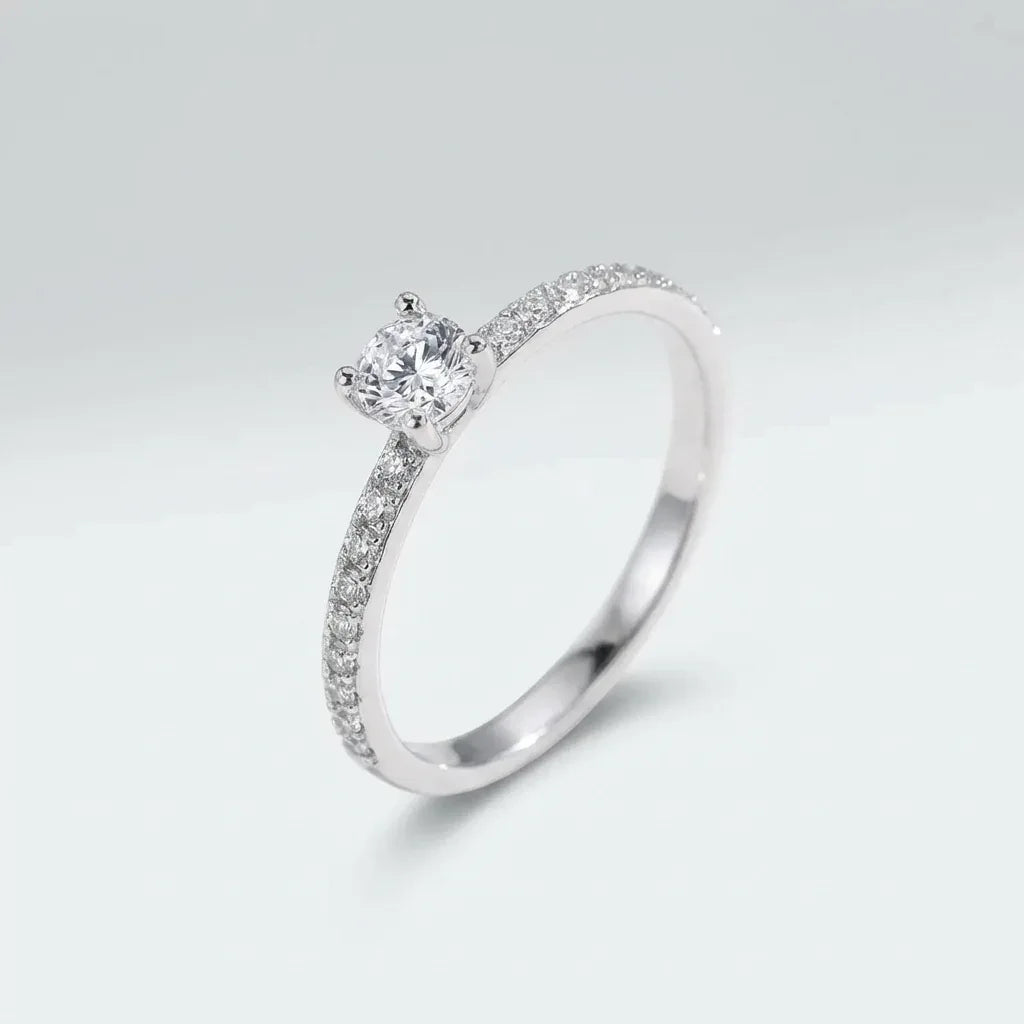
Every Lumière piece is set with GIC Certified D Color VVS1 Moissanite.
Crafted in S925 silver or 14K gold fill. Ships in 24h. 30-day returns.